THE CHARTREUX CAT, A RECONSTITUTED BREED
An interesting breed, of very ancient origin and well-defined type, several specimens of which were found on Belle-Île-en-Mer, and with which breeding and selection could be undertaken.
The Chartreux cat, often confused with the Blue British or the Blue Russian, is still little known.
This breed was on the verge of disappearing altogether a few years ago, and it was a happy accident that led us to find a few specimens and to start breeding them.
At present, we know of hardly any breeding programme in France other than our own. Mention must be made, however, of the efforts of Mr. and Mrs. Trafford, who have a couple of great beauty, whose male, Hector de Guerveur, is about to become a champion.
ORIGINS. The origin of the Chartreux cat is still very poorly known. Having bred this cat for some ten years, we wished to learn about its origin; unfortunately, our efforts to trace the stock and the standard of these cats have met with only relative success. What is certain is that this is a quite distinct breed, which cannot be assimilated to any other. Indeed, the name Chartreux was not invented; it is not a vague label, but truly the name of the breed.
We found in the 1756 edition of Buffon's Histoire naturelle (vol. 6, page 12) a description of this cat, which he calls "Chat des Chartreux" and of which he even gives a plate (Pl. IV). Unfortunately, Buffon says hardly anything about the colour of this cat (ash grey) and nothing about the colour of its eyes or its structure. Yet, looking at the plate, it is easy to see that it is a cat with a very long back, rather high on its legs and with a long, tapering tail. It is difficult to judge the head from it.
René Primevère Lesson, in his manual of mammalogy, 1827 edition, discusses the genera of Felis Catus after Linnaeus and lists four varieties: the domestic cat, the Spanish cat, the Angora cat and finally the Chartreux cat (Felis cæruleus).
In Trouessart's great Encyclopaedia, page 877, we again find mention of the Chartreux cat. Trouessart calls it Chat des Chartreux (Felis domesticus cæruleus) and believes it to be a cross between the Egyptian cat and Felis manul. We are a long way from the blue cat of Russia and Great Britain.
It is therefore reasonable to believe that the name Chartreux has an authentic origin, which unfortunately we have not been able to trace, and it is probable that in some Charterhouse the Fathers bred and selected this breed and gave it their name, just as happened with the Saint Bernard dog of Mont Saint-Bernard, bred and selected by the monks.
RECONSTITUTION OF THE BREED
Our first specimens are of French origin; they were found in France, and we imported nothing from abroad.
From the first year of our settling on Belle-Île, we were struck by the number and beauty of some blue short-haired cats, known at Le Palais as "the hospital cats" (a hospital run by a religious order). In the countryside we also found some of these cats and, remarkably, all had the same type and, despite crossings with the local European cats, kept the characteristics of the breed.
We acquired several of these cats (I can say that we have now gathered all the fine specimens on the island) and, from the very first generation, we obtained remarkable results. From the first mating of a blue tom with a blue queen we had a litter of kittens that were all blue and true to type. It therefore seems that this was more than chance: in our view, evidently, the reconstitution of a breed that, through the years and the crossings, has kept its essential characteristics.
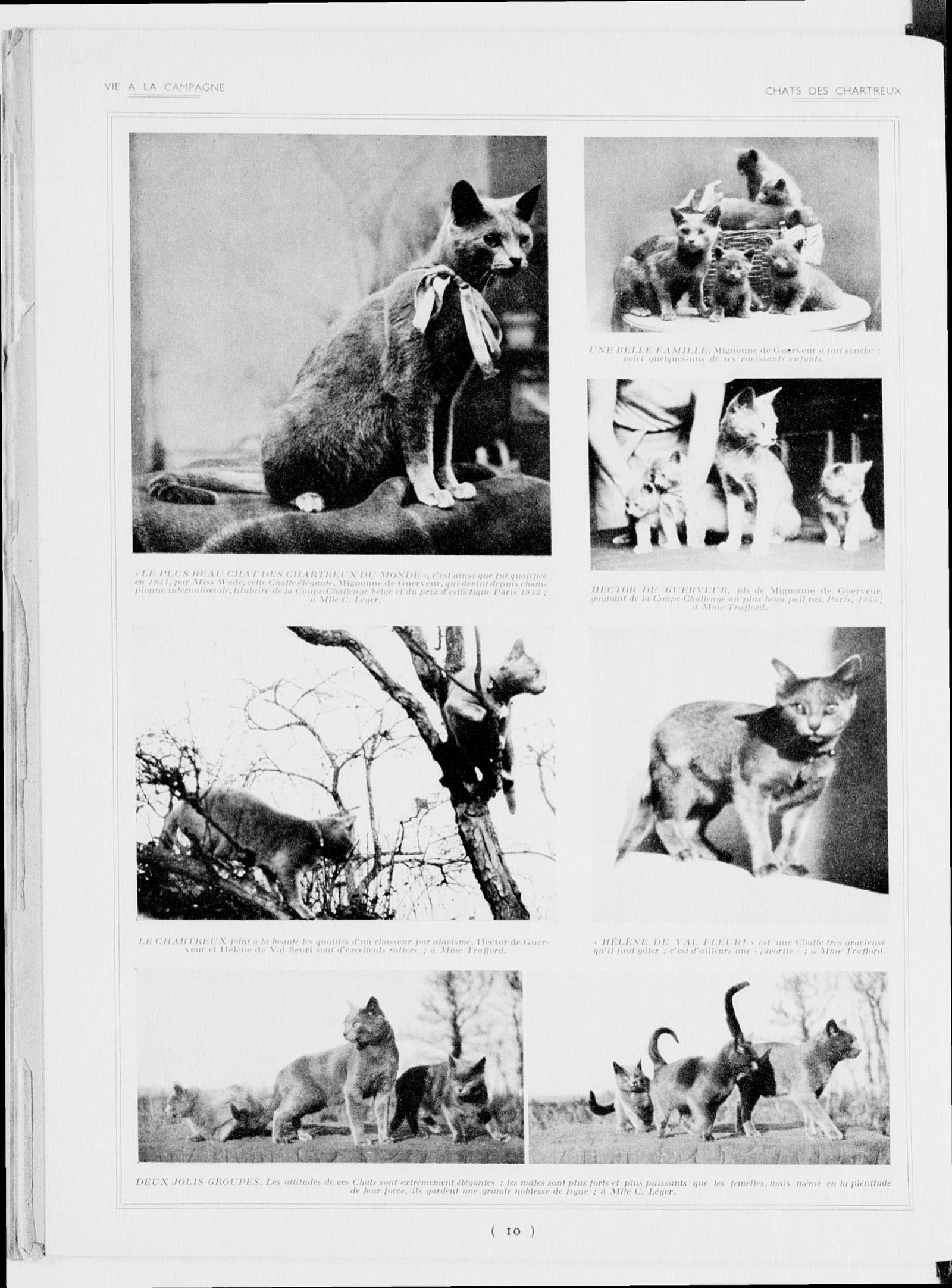
From the first blue queen acquired at Le Palais, Marquise, mated by us to a blue tom from the hospital, Coquito, was born the famous Mignonne, who subsequently became an international champion, holder of the Belgian challenge cup and of the Paris 1933 aesthetics prize (Cat-Club de Paris) for the most aesthetic cat of the whole show, judged by Miss Wade, who examined her in Paris in 1931 as "the most beautiful Cat of Chartreux in the World".
Mignonne was the foundation of our cattery, and given her successes it is permissible to base the type of the breed on her.
Now, Mignonne is neither a Blue-British nor a Blue-Russian. The Blue-British is a massive cat with golden eyes; the Blue Russian a slender cat with green eyes. Mignonne is a slender cat with golden eyes.
THE IDEAL TYPE
General appearance: Extremely elegant, with an innate grace (which won her the aesthetics prize), she is not very large, even rather small. The male is stronger, more powerful and larger; yet he must not have an overly heavy bone structure and must also keep, even in the fullness of his strength, his line and his elegance.
Head: It closely recalls that of the Siamese in its elongated shape and absence of jowls (bajoues). Nose leather silver-grey, more or less dark according to the coat; it must on no account be pink or depigmented. Lips: very dark blue, almost black, as is the palate. Eyes: pale gold in Mignonne; we have since obtained copper eyes in some of her children (Gouerch) and grandchildren (Hoëdic), and this is the colour to aim for. A green reflection is often seen in the eye, but through selection it can be eliminated. Ears: large, set well upright; they give the cat an alert look.
Skull: rather flat and rather narrow, entirely recalling the Siamese in shape. Jaws: fairly strong, well set. Cheeks: lean and without jowls (bajoues), especially in the female. Nose: fairly long, without being excessive, preferably with a slight break at the base which gives the muzzle a well-defined shape. Neck: long; it contributes to the line of the cat and makes it carry itself well when it raises its head, attentive.
Body: the shoulder is long, well attached, with a pleasing curve; it is well muscled; the forearm continues it agreeably to the eye and is likewise long and slender. Paw: round, small, of exquisite fineness; sole dark grey, almost black.
Chest: deep, descending to the level of the elbow, and broad. Back: long, well muscled, extremely supple. Belly and flank: the belly, little developed, must be that of the carnivore par excellence; the flank will hang little and will not weigh down the line of the body as a whole. Hindquarters: the rump must be sloping, yet continue the line of the back. Thighs: very muscular, long, with, like the shoulder, a curve pleasing to the eye. Tail: is one of the principal characteristics of this cat, very long, tapering, carried high and gaily.
Coat: its shade varies from silver-grey to slate-blue. Mignonne and Hector are very light, of a silvery tone growing lighter on the legs and muzzle: the ideal coat. Unfortunately it seems that this light coat goes hand in hand with a pale gold eye; indeed Gouerch and Hoëdic, who have a copper eye, have a slate coat. It is no longer the becoming dress of Mignonne and her son, but the eye gains in beauty. White hairs in the coat, and a patch, are a disqualifying fault. These cats are often more or less striped with darker blue when young; but with age these shadows must disappear completely.
Hair: the texture of the hair must be woolly and, when stroking the cat against the lie of the coat, you must have the impression of touching velvet; in other words, short, woolly, dense hair. Skin: when the hair is parted, the skin appears uniformly blue, without any white or pinkish patch.
Weight and size: females weigh from 2.5 to 3 kg, males from 3 to 4 kg. Neutered cats may naturally exceed this weight. The size is that of the Siamese. Gait: supple, very feline. Faults: white hairs, a coat of a colour other than blue-grey; stripes in the coat in adults, heavy structure, exaggerated size and weight, heavy and massive head, jowls, green eyes. Disqualifying fault: white patch in the coat.
SCALE OF POINTS: General structure, 20; Eye colour, 20; Head: ears, 5; nose or muzzle, 5; cheeks, 5; general shape, 5; Texture of the hair, 10; Coat colour, 20; Tail, 10. Total, 100.
QUALITIES AND APTITUDES
The Chartreux cat is above all a hunter by atavism. That is its purpose and, if cat contests were possible, I would not hesitate to pit my specimens against the famous ratting cats of Le Havre. It is precisely in this that this breed is so interesting, for it joins to beauty the qualities of the cat par excellence. The reason for which it was created is fulfilled, and we are not dealing with one of those lazy cousins who lounge about night and day.
When I let my old Dolcis out on mild nights, he brings me back every morning, on the doorstep, one of those enormous coast rats, as big as a 6-month-old kitten, with which the country is infested. He also hunts the blue rat of our granaries, reputed to be uncatchable.
Espiègle, at 4 months, in front of a mouse nest I had found for him under some maize, caught two mice in his mouth in the blink of an eye and one under each paw. The young Fftfft, at two months, caught a field mouse for me and I had to get angry and beat him so that he would not eat it. A feast for the eyes, peace of a home rid of rodents: here is the Chartreux cat.
Of independent character, it does not like to be picked up; it accepts caresses from its owners but distrusts strangers; very affectionate with people it knows, it is less so with its fellows; and in the family there are often quarrels! I have seen, among others, Mignonne deliver a slap with the flat of her paw to one of her daughters who was teasing her, and it is the funniest thing I have ever observed.
MANAGEMENT OF THE CATTERY
The Chartreux cat is very hardy; although, like its friend the European cat, it pays a rather high toll to the dreadful typhus [feline panleukopenia], it is more resistant than the Persian and infinitely more so than the Siamese.
On Belle-Île we have an extremely harsh climate because of the damp and the wind, and I had to give up breeding Siamese, which all died of coryza. My Persians withstand it fairly well; my Chartreux are "at home".
Although I have set up cat houses, I let my Chartreux run completely free whenever I can; only queens about to come into season and wandering toms are always shut in.
As for food, in the country I give them an almost exclusively meat diet; in town, I moderate the consumption of meat. I always prevent them from eating their prey when possible, for I have noticed real cases of poisoning from rats and moles; besides, when well fed, they hunt for pleasure and almost always bring back their prey.
The queens are fairly prolific; yet it is exceptional for them to have more than one litter a year; I do not seek it, in any case, for it would tire them. Kittens are born in numbers of 3 or 4; I did, however, own a queen who gave me 8 kittens every time, which is not to be sought, since the little ones are born weak and rear badly. Whenever possible and the weather is favourable, the kittens are raised at liberty and brought in only at night or in bad weather. In this way I obtain very vigorous specimens.
These cats need little care; in the country their coat always stays clean; a simple brushing is enough before showing them.
There is at present no Chartreux Cat Club; the creation of such a Club should be considered and would certainly be of interest, for the number of its friends grows from day to day.
PRINCIPAL CHAMPIONS
Several of our pupils have won the championship, and these are the only champions I know of in France. International champion: Mignonne de Guerveur, who has notably won 38 prizes, including 20 firsts, 6 C. A. C., 12 special prizes and prizes of honour. Her daughter, international champion Gouerch de Guerveur of the Société centrale féline and the Club des Amis des Chats; holder of 17 first prizes, 4 C. A. C., 6 special prizes, etc., who at her last showing, in Paris, in January 1935, won the prize of honour awarded to the most beautiful short-haired Champion; also a son of Mignonne, Hector de Guerveur, about to become a champion, who also won, in Paris, in January 1935, the challenge cup for the finest short coat in the whole show; a great-grandson of Mignonne, the handsome Hoëdic de Guerveur, holder of 15 first prizes, 4 C. A. C., P. S. and F. H., currently also an international champion.
Our cattery was awarded, in 1933, the prize of honour of the President of the Republic, given to the finest cattery of short-haired cats.
FUTURE OF THE BREED. This breed is still little known (witness the extravagant remarks of visitors at shows), and it is to be hoped that our societies will popularise the breed rapidly and show that it has its own characteristics, its own interest and its own usefulness.
C. LÉGER.